 Live Grade
How to Calculate LSAC GPA (Step-by-Step Guide)
By Usama, Law School Admissions Content Specialist | Published:
Calculating your LSAC GPA is not the same as calculating your college GPA. The Law School Admissions Council (LSAC) applies a standardized evaluation methodology that differs from institutional grading policies. This recalculated GPA appears on your Academic Summary Report and is reviewed by all ABA-accredited law schools during the admissions process.
This guide is based on LSAC’s official Credential Assembly Service (CAS) GPA calculation methodology used in law school admissions. It explains how LSAC evaluates undergraduate transcripts, including repeated coursework, failing grades, withdrawals, and grading conversions. The steps outlined below reflect the same evaluation process LSAC uses when generating the Academic Summary Report sent to law schools.
By the end of this guide, you will understand not only how to calculate your LSAC GPA accurately, but also why it often differs from the GPA reported by your undergraduate institution.
What Is LSAC GPA?
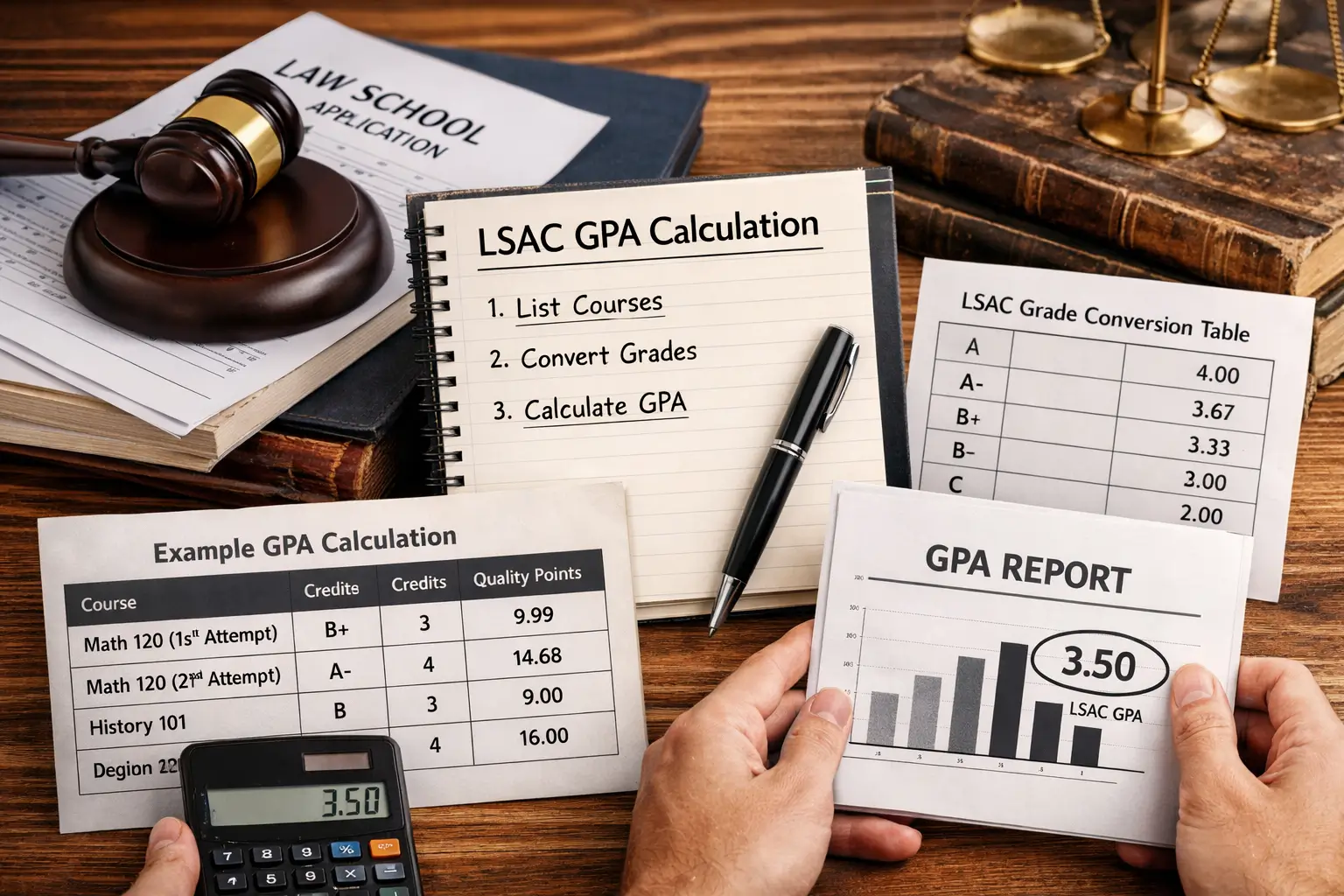
The LSAC GPA is a standardized grade point average recalculated by the Law School Admissions Council (LSAC) through its Credential Assembly Service (CAS) for U.S. and Canadian law school applicants. It is not taken directly from your undergraduate institution’s GPA. Instead, LSAC independently evaluates all eligible undergraduate coursework using a uniform grading methodology.
This recalculated GPA appears on your Academic Summary Report, which is included in your CAS report and sent to law schools as part of the admissions process. For most ABA-accredited law schools, the CAS GPA is the primary GPA used when reviewing applicants, rather than the GPA listed on the college transcript.
Because colleges and universities apply different grading scales, course repeat policies, and academic forgiveness rules, LSAC standardizes GPA calculations to eliminate institutional variability. This ensures that all applicants are evaluated consistently and equitably under the same grading framework.
How LSAC GPA Is Different From College GPA
The LSAC GPA often differs from your college or university GPA because LSAC does not apply institutional grading policies. Instead, LSAC evaluates every transcript using a standardized grading framework to ensure consistency across all applicants.
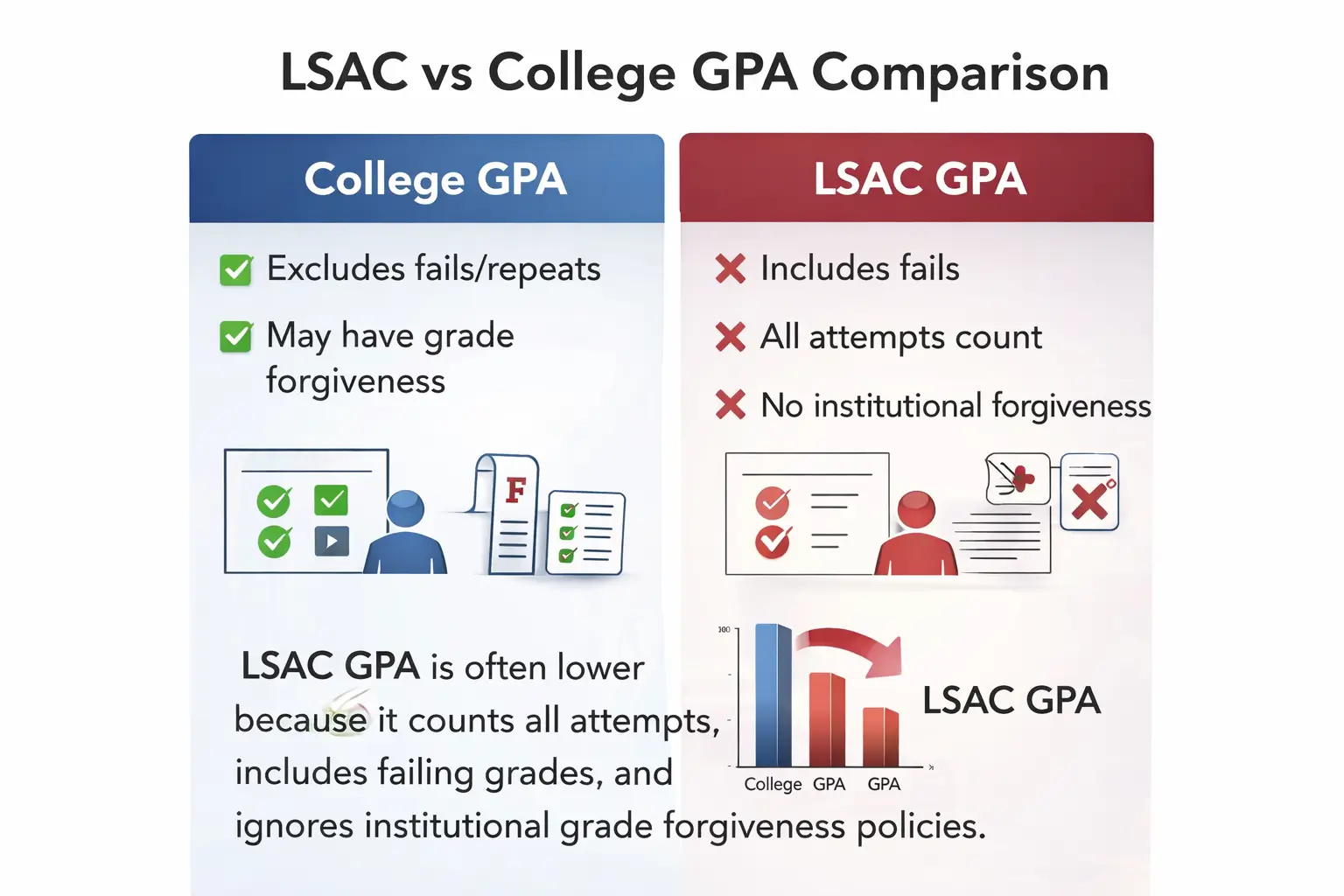
According to LSAC’s official transcript evaluation policies, several rules explain why the LSAC GPA frequently differs from an undergraduate institutional GPA.
Key Differences Between LSAC GPA and College GPA
All course attempts are counted.
If you repeated a course to improve a low grade, LSAC includes both the original and repeated grades in the GPA calculation. Many colleges replace the earlier grade; LSAC does not.
Failed courses are included.
Any course with a failing grade that appears on the transcript is included in the LSAC GPA, even if the course did not count toward graduation or was later retaken.
Institutional grade forgiveness is ignored.
Academic amnesty, grade replacement, and similar institutional forgiveness policies do not affect LSAC GPA calculations if the original grade remains visible on the transcript.
Withdrawals are evaluated by notation.
Non-punitive withdrawals (such as W) are generally excluded, while punitive withdrawals (such as WF) are typically treated as failing grades.
Pass/fail courses are generally excluded.
Courses graded strictly as pass/fail do not affect the LSAC GPA unless a failing grade is explicitly recorded.
Because of these policies, the LSAC GPA is often lower than the GPA reported by an undergraduate institution—particularly for applicants who repeated courses or benefited from institutional grade-forgiveness policies.
Understanding these differences is essential before attempting to calculate your LSAC GPA. Applying your school’s GPA rules will almost always result in an inaccurate calculation.
LSAC GPA Calculation Rules
These rules reflect LSAC’s official Credential Assembly Service (CAS) transcript evaluation standards.
LSAC calculates GPA using a strict, rules-based methodology designed to standardize undergraduate academic records across all applicants. Before performing any calculations, it is essential to understand which grades and credits are included and how LSAC evaluates them.
Undergraduate coursework only.
The LSAC GPA includes all undergraduate-level courses completed before your first bachelor’s degree was awarded. Any coursework completed after degree conferral—such as post-baccalaureate or graduate coursework—is excluded from the LSAC GPA calculation.
All transcripted grades are evaluated.
Any grade that appears on your official undergraduate transcript is subject to LSAC evaluation. Grades are generally counted regardless of whether your institution considers them forgiven, waived, or excluded from its own GPA calculation.
Credit hours determine weighting.
Each course is weighted according to the number of credit hours assigned by the institution. Courses with higher credit values have a greater impact on the final LSAC GPA.
Letter grades are converted to LSAC grade points.
LSAC converts all letter grades into standardized numeric grade points using its official conversion scale. These grade points are then multiplied by the course’s credit hours to calculate quality points.
Pass/fail and ungraded courses.
Courses graded strictly as Pass (P), Credit (CR), or Satisfactory (S) are generally excluded from LSAC GPA calculations. However, a recorded Fail (F) or No Pass (NP) may be included if it carries numerical weight on the transcript.
Withdrawals depend on transcript notation.
Non-punitive withdrawals (such as W) are typically excluded, while punitive withdrawals (such as WF) may be treated as failing grades.
Remedial or developmental coursework.
Remedial or developmental courses may be included in the LSAC GPA if they appear on the transcript with assigned grades and credit hours.
These principles form the foundation of the LSAC GPA calculation. Once you understand what coursework is included and how it is weighted, you can accurately calculate your LSAC GPA using the official conversion scale and formula used by LSAC.
LSAC Grade Conversion Table
Before calculating your LSAC GPA, all letter grades must be converted to LSAC grade points. The Law School Admissions Council (LSAC) uses a standardized conversion scale to ensure consistency across different colleges and grading systems.
| Letter Grade | LSAC Grade Points |
|---|---|
| A+ | 4.33 |
| A | 4.00 |
| A− | 3.67 |
| B+ | 3.33 |
| B | 3.00 |
| B− | 2.67 |
| C+ | 2.33 |
| C | 2.00 |
| C− | 1.67 |
| D+ | 1.33 |
| D | 1.00 |
| D− | 0.67 |
| F | 0.00 |
If your college does not use plus or minus grades, LSAC converts your grades to the closest equivalent. Numeric, percentage-based, and alternative grading systems are also standardized during transcript evaluation.
This conversion is essential because LSAC GPA calculations are based on grade points multiplied by credit hours—not your institution’s GPA formula. Once grades are converted, you can calculate total quality points to determine your final LSAC GPA accurately.
Step-by-Step: How to Calculate LSAC GPA
Calculating your LSAC GPA follows a standardized method used by the Law School Admissions Council (LSAC) through the Credential Assembly Service (CAS). Follow these steps carefully to ensure accuracy.
Step 1: Identify all eligible undergraduate coursework
Include all courses listed on your official transcript completed before your first bachelor’s degree. Don’t forget:
- Dual enrollment or college courses taken in high school
- Summer or community college courses
- Study abroad grades listed on your transcript
- Repeated courses and failed courses
- Withdrawals with recorded grades
Exclude post-baccalaureate, graduate, or professional coursework.
Step 2: Record credit hours
Note the number of credit hours assigned to each course. Remember:
- Quarter system schools: Convert quarter hours to semester hours using
Semester Hours = Quarter Hours × 2/3. - Courses with higher credit hours carry more weight in your LSAC GPA.
Step 3: Convert letter grades to LSAC grade points
Use the official LSAC grade conversion table. Do not use your institution’s GPA.
Step 4: Calculate quality points
Multiply the LSAC grade points by the course’s credit hours to determine quality points for each course.
Step 5: Total quality points
Add all quality points from included courses to get total quality points.
Step 6: Total graded credit hours
Add the credit hours for all courses included in the GPA calculation.
Step 7: Divide to get LSAC GPA
LSAC GPA = Total Quality Points ÷ Total Graded Credit Hours
Step 8: Consider withdrawals
LSAC treats withdrawals differently depending on transcript notation. Reference this table:
| Notation | Impact on LSAC GPA | Reason |
|---|---|---|
| W / WP | Neutral (Excluded) | Non-punitive withdrawal |
| WF / WU | 0.00 (Fail) | Punitive withdrawal |
| NC / NP | Variable | Counts as F if considered punitive |
Step 9: Study abroad & transfer grades
If study abroad or international grades appear on your primary US/Canadian transcript, include them. Transfer credits without grades generally do not count.
Key Tip: Follow all these steps to match LSAC’s official CAS methodology. Excluding repeated grades, ignoring failed courses, or applying institutional forgiveness policies will result in an inaccurate LSAC GPA.
Example LSAC GPA Calculation (with Quarter-to-Semester Conversion)
This example demonstrates how LSAC evaluates repeated courses, converts quarter hours to semester hours, and calculates your GPA using official LSAC grade points.
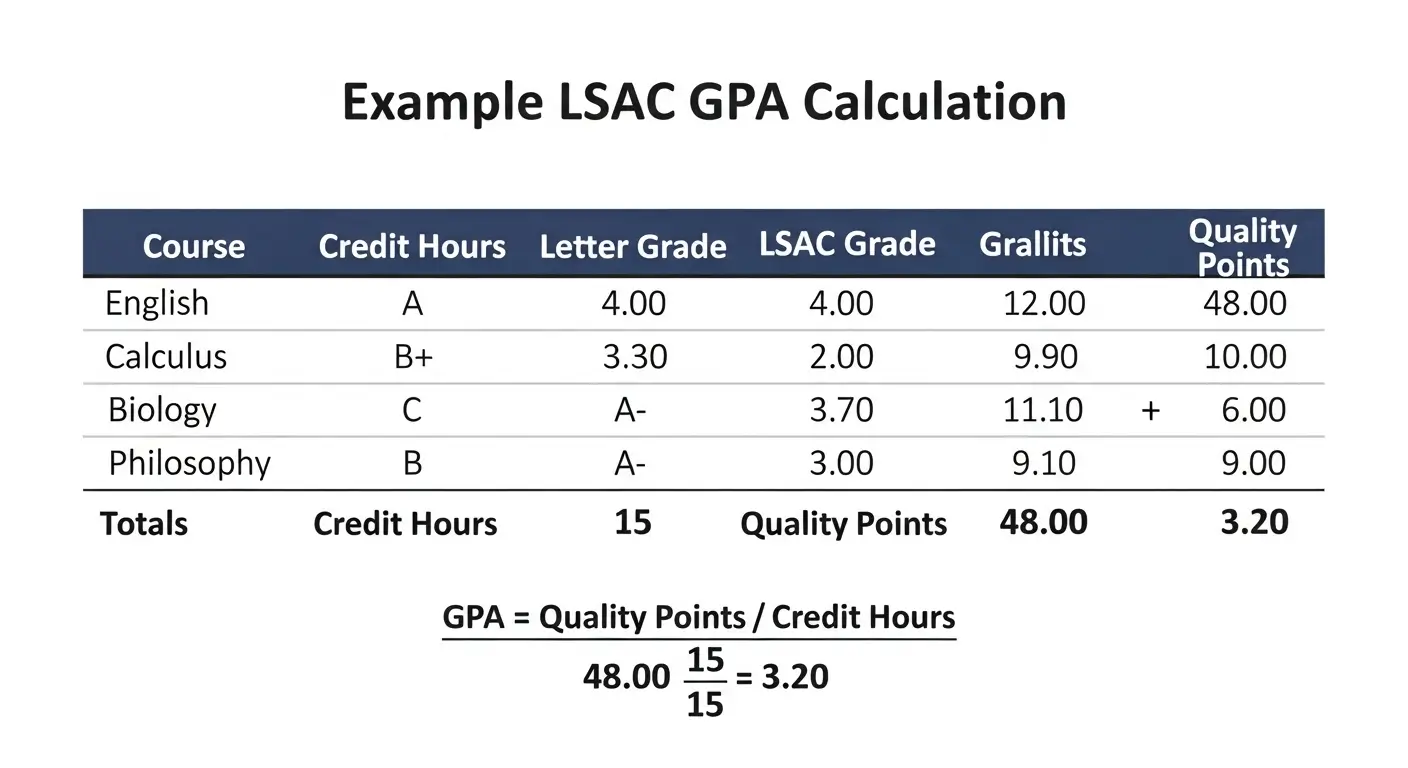
| Course | Credit Hours | Letter Grade | LSAC Grade Points | Quality Points |
|---|---|---|---|---|
| English 101 | 3 | A | 4.00 | 12.00 |
| Biology 110 | 4 | B− | 2.67 | 10.68 |
| History 205 | 3 | C+ | 2.33 | 6.99 |
| Math 120 (Quarter School - First Attempt) | 4 × 2/3 = 2.67 | D | 1.00 | 2.67 |
| Math 120 (Quarter School - Repeat) | 4 × 2/3 = 2.67 | B | 3.00 | 8.01 |
Step 1: Total Quality Points
Add all quality points: 12.00 + 10.68 + 6.99 + 2.67 + 8.01 = 40.35
Step 2: Total Graded Credit Hours
Sum all semester-adjusted credit hours: 3 + 4 + 3 + 2.67 + 2.67 = 15.34
Step 3: Calculate LSAC GPA
LSAC GPA = 40.35 ÷ 15.34 = 2.63
Key Takeaways:
- Both attempts at Math 120 are included in the calculation, as LSAC counts all repeated courses.
- Quarter hours are converted to semester hours (× 2/3) to standardize GPA across institutions.
- Failed courses and repeats can lower your LSAC GPA compared to your institutional GPA.
- This methodology ensures consistency and fairness for ABA-accredited law school admissions.
Common Mistakes Students Make When Calculating LSAC GPA
Many law school applicants miscalculate their LSAC GPA by following their undergraduate institution’s GPA rules rather than LSAC’s official methodology. Avoiding these mistakes is critical, as even small errors can significantly affect how admissions committees view your academic record.
1. Excluding repeated courses
A common misconception is to only count the highest grade for repeated courses. LSAC includes all attempts, even if your grade improved on subsequent attempts. Skipping any attempt will produce an inaccurate GPA.
2. Ignoring failed grades
Some students assume that failing courses no longer count if the credit was not applied toward graduation. Any failing grade visible on your transcript is included in LSAC’s calculation, regardless of institutional policies.
3. Applying institutional grade forgiveness
Policies such as academic forgiveness, grade replacement, or grade amnesty used by your college do not apply to LSAC GPA calculations. All original grades listed on your transcript are considered.
4. Mishandling withdrawals
Treating all withdrawals as non-penalties is incorrect. Withdrawals marked with penal designations (e.g., WF) may be counted as failing grades. LSAC evaluates each withdrawal individually based on transcript notation.
5. Including post-baccalaureate coursework
Courses taken after earning your first bachelor’s degree—such as graduate or post-baccalaureate coursework—are excluded from your LSAC GPA, even if they are academically relevant.
6. Using standard GPA calculators
Most online GPA calculators follow institutional grading rules and cannot accurately reflect LSAC’s methodology. Using them will often result in an incorrect CAS GPA.
Key takeaway: Carefully following LSAC’s official rules ensures accurate GPA calculation. Avoiding these common errors can help you present a clear and reliable academic profile to law school admissions committees.
FAQs – People Also Ask About LSAC GPA
Does LSAC recalculate GPA?
Yes. LSAC recalculates all undergraduate coursework using the Credential Assembly Service (CAS) to generate a standardized GPA for law school admissions. This ensures consistent evaluation across all applicants, regardless of differing institutional grading policies.
Do repeated courses count toward the LSAC GPA?
Yes. LSAC includes every attempt of a repeated course. Both the original and subsequent grades are counted when calculating your CAS GPA.
Do failed courses count?
Yes. Any failing grade listed on your official transcript is included in the LSAC GPA calculation, even if the course was later retaken or the credit was not applied toward graduation.
Does LSAC GPA replace my undergraduate GPA?
No. Your undergraduate GPA remains on your transcript, but law schools primarily reference your LSAC GPA when evaluating applications. The LSAC GPA is the standard metric for fair comparison among applicants.
Are pass/fail courses included?
Generally, no. Courses graded strictly as pass/fail, credit, or satisfactory (e.g., P/NP, CR, S) are excluded unless a failing grade is recorded.
Why is my LSAC GPA lower than my college GPA?
LSAC GPA may be lower because it counts all course attempts, includes failing grades, ignores institutional grade forgiveness policies, and excludes post-baccalaureate or non-graded courses. These rules create a standardized GPA that often differs from your transcript GPA.
About the Author
Name: Usama
Role: Law School Admissions Content Specialist
with extensive experience explaining LSAC policies, CAS GPA calculations, and law school application strategies. He provides authoritative guidance for U.S. and Canadian law school applicants based on official LSAC standards.
References & Resources
- LSAC GPA Calculator: https://livegrade.site
- For accurate LSAC information, applicants should consult the official LSAC CAS website.